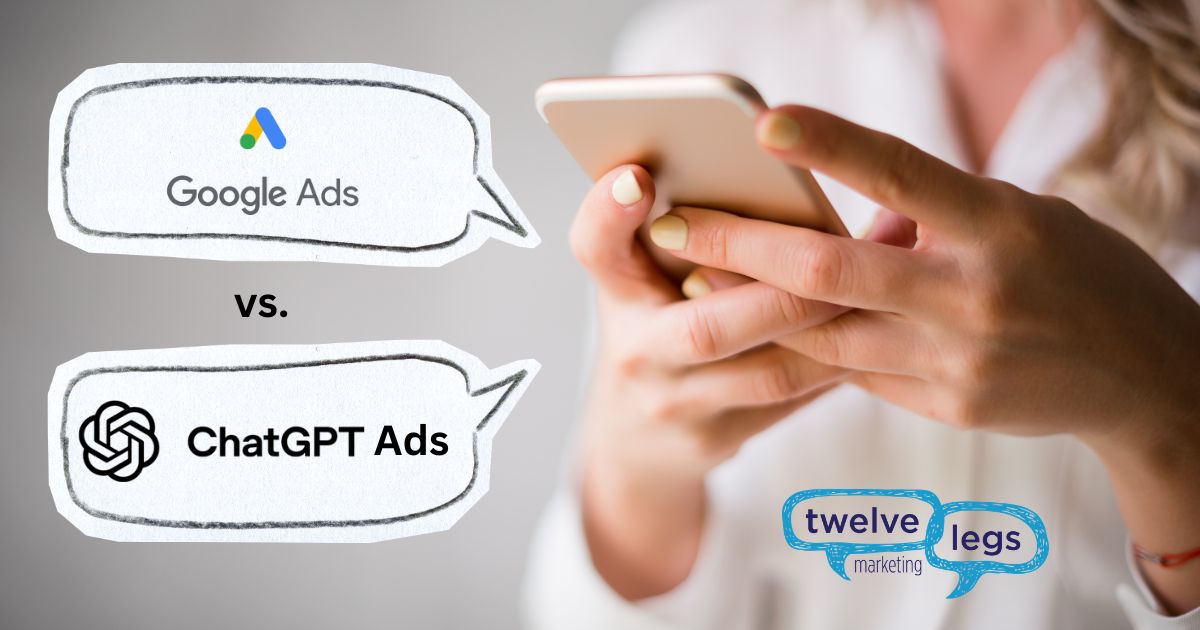
ChatGPT now has ads, and suddenly every marketing team is asking the same question:
Should we be advertising here?
The noise is loud. There are articles about a new advertising frontier, speculation about what AI could mean for paid media, and early stories from brands trying to understand a channel that is still being built.
Somewhere in all of that, a critical distinction is getting buried.
ChatGPT Ads are not another version of Google Ads.
And brands that approach them as though they are may end up evaluating the channel against expectations it was never designed to meet.
We’ve been testing ChatGPT Ads with our own budget, studying how the platform works, and comparing what advertisers can—and cannot—do here against mature platforms like Google Ads.
What we have found is worth understanding before you move budget into the channel.
Especially if you’re considering whether your business should be an early mover or wait until the platform matures.
When business owners ask us about ChatGPT Ads, there’s usually another question underneath the surface:
Is this basically Google Ads inside ChatGPT?
No.
The distinction starts with something very simple:
Google is primarily built around searching. ChatGPT is built around conversation.
That changes the user.
It changes the intent.
It changes the targeting.
It changes the creative.
It changes the data available to advertisers.
And, perhaps most importantly, it changes what you should reasonably expect your advertising dollars to accomplish.
Someone opening Google often knows what they want.
They might search:
“Commercial movers near me.”
They have translated their problem into a keyword. Google can match that explicit search with relevant businesses.
But imagine the actual problem is more complicated:
We need to relocate the server room in our corporate office without taking our systems offline. Who handles something like that?
That is where conversational search becomes interesting.
The buyer may not know the category name.
They may not know whether they need a commercial mover, IT relocation company, server migration specialist, technology logistics provider, or something else entirely.
They just know the problem.
Traditional paid search requires marketers to anticipate the words someone will type.
Conversational advertising creates the possibility of reaching people based on the larger problem they are trying to solve.
That may ultimately become one of ChatGPT Ads’ most meaningful advantages.
The podcast transcript makes this same point using a specialized technology-moving company: services that are difficult to capture through one clean keyword or keyword phrase may be particularly interesting candidates for contextual advertising.
This is the mindset shift marketers need to make.
In Google Ads, the question is often:
What keywords should we bid on?
In ChatGPT Ads, the better question becomes:
What conversations should our company be relevant to?
Those sound similar.
They aren’t.
A keyword describes what somebody typed.
A conversation can reveal:
That gives advertisers something fundamentally different to work with.
But—and this is important—the platform does not currently give advertisers the same level of visibility back into those conversations.
That creates both the opportunity and the limitation.
This may be the most important expectation to set before advertising on ChatGPT.
Google Ads has conditioned experienced advertisers to expect an enormous amount of diagnostic information.
Even when a Google Ads campaign isn’t generating enough conversions, we can still ask:
That information gives an advertiser something extremely valuable:
ChatGPT Ads currently offer significantly less visibility.
One advertiser documented seeing spend, impressions, clicks, CTR and CPC, but could not see the underlying searches or conversational context that led to those clicks. His frustration wasn’t simply that his test generated no conversions. It was that there was very little data available to diagnose whether the campaign was moving in the right direction.
That’s a major distinction.
If a Google campaign gets 100 clicks and no leads, we can often investigate those 100 clicks.
If a ChatGPT campaign gets 100 clicks and no leads, advertisers may have much less information explaining who those clicks represented, what prompted them, and whether the contextual match was as good as expected.
That affects optimization.
And it should affect how businesses judge early tests.
There is a tendency whenever a new platform arrives to immediately declare the incumbent obsolete.
That would be a mistake here.
Google Ads currently has two enormous advantages:
Google still represents a massive pool of demand from people explicitly looking for products, businesses and services.
When somebody already knows what they want, Google is remarkably efficient at connecting that demand with businesses competing to fulfill it.
ChatGPT does not need to replace that behavior to become valuable.
It may occupy a different part of the customer journey entirely.
Google’s complexity can be frustrating.
But that complexity is also one of its biggest strengths.
Search terms, keywords, geography, devices, audience data, conversion signals and other reporting give experienced marketers ways to investigate performance and make informed changes.
ChatGPT Ads are considerably more opaque today. The podcast tester described the current experience as being able to see what was spent and how many impressions or clicks resulted, without enough context to deeply analyze the traffic behind them.
That doesn’t mean ChatGPT Ads don’t work.
It means there are fewer levers to pull and fewer diagnostic clues available when they don’t.
This is where we see brands getting the strategy wrong.
They build context descriptions that resemble keyword lists.
They write aggressive direct-response ads.
They optimize around the click.
They expect traditional paid-search conversion rates.
They move money out of proven Google campaigns to fund the experiment.
Then they ask:
What’s our cost per lead?
That question may eventually be appropriate.
Right now, it is often too narrow.
ChatGPT advertising should initially answer a different set of questions:
Can we become relevant inside conversations that matter to our customers?
What type of message earns attention in that environment?
What topics create engagement?
Does traffic from conversational discovery behave differently from traditional paid search traffic?
Can we reach potential customers earlier than we could through keyword-driven advertising?
Those are learning questions.
And learning is the primary asset early adopters should be buying.
Google intent signals are explicit.
Someone types:
“Wedding tent rental Denver.”
There’s very little ambiguity.
ChatGPT intent can be much broader.
Someone might be planning an outdoor wedding and asking:
They haven’t necessarily searched for a tent rental company.
But they’re deeply inside the problem that a tent rental company solves.
Advertiser’s job: Become relevant to the customer’s thinking.
Mindset shift: Stop asking only, “What would somebody search?”
Start asking:
“What would somebody be talking about before they realize they need us?”
That is a much more interesting demand-generation question.
Google often captures demand near the bottom of the funnel.
The user says:
I need this.
Google answers:
Here are companies selling it.
ChatGPT can encounter the customer substantially earlier.
The user may still be researching, comparing or defining the problem.
That creates an advantage and a disadvantage.
The advantage is earlier influence.
The disadvantage is lower immediate buying intent.
A relevant ad does not automatically mean someone is ready to submit a form.
That’s why interpreting ChatGPT click-through rates exactly like Google Search click-through rates can be misleading.
The platforms are catching the customer at different moments.
Traditional paid-search advertising tends to push action:
Get a Quote.
Schedule a Consultation.
Shop Now.
See Pricing.
Those calls to action make sense when somebody has already reached the decision stage.
But interrupt a thoughtful research conversation with:
BUY NOW!
and you’ve changed the tone of the experience.
ChatGPT Ads should feel useful before they feel promotional.
That means creative may work better when it:
Your advertisement doesn’t necessarily need to close the sale.
It may need to earn the next interaction.
There is another dynamic worth watching.
Google is a commercial battlefield.
Users know businesses are bidding to appear at the top.
They also know organic results are influenced by years of SEO, content development, backlinks and optimization.
ChatGPT feels different.
People often experience the response as something created specifically around their question and circumstances.
That personalization can create a different psychological environment for an advertiser.
The podcast transcript argues that ChatGPT currently feels less overtly commercial and therefore may carry a different level of perceived authenticity or trust than a traditional search-results page.
That does not mean users automatically trust advertisements appearing in ChatGPT.
But it does suggest something strategically important:
An ad that genuinely belongs alongside the conversation may feel helpful.
An ad that feels forced may stand out even more.
That puts enormous importance on relevance and creative restraint.
One of the most interesting opportunities may be businesses whose products or services are difficult to describe through simple keywords.
Think about companies selling:
Google works exceptionally well when demand has already been translated into a search query.
ChatGPT could become especially valuable when customers are still describing the problem instead of naming the solution.
That distinction deserves much more attention than simply asking which platform has the cheaper CPC.
There is an uncomfortable reality here:
ChatGPT Ads are currently harder to diagnose.
That means marketers need to resist false precision.
A campaign may generate clicks without enough underlying information to confidently explain why a particular user clicked.
A campaign may fail to convert without giving advertisers the same search-term-level evidence they are accustomed to using in Google Ads.
And some interactions may happen early enough in the buying process that eventual conversions occur through another channel.
So instead of asking only:
an early ChatGPT Ads test may also need to consider:
This is not an argument for avoiding accountability.
It’s the opposite.
Good measurement starts by measuring a channel according to what it is actually capable of telling you.
At this point, you may reasonably ask:
If ChatGPT Ads have less volume, less reporting depth and fewer optimization tools than Google Ads, why advertise there at all?
Because mature channels and emerging channels create different kinds of advantages.
Google gives you infrastructure.
ChatGPT currently gives early adopters an opportunity to build institutional knowledge before everyone else has it.
The brands experimenting now are learning:
That knowledge compounds.
Once every advertiser understands the medium, understanding stops being an advantage.
Execution becomes the advantage.
Right now, there is still room to develop both.
This is one point we want to make especially clear.
If your Google Ads campaigns are generating qualified leads profitably, do not cut them simply because ChatGPT Ads are new.
These platforms currently solve different marketing problems.
Google captures existing demand extraordinarily well.
ChatGPT may help brands influence customers earlier in the research and consideration process.
Those can complement each other.
They should not automatically cannibalize each other.
A smart early test uses:
That allows you to experiment without sabotaging a proven acquisition channel.
The goal isn’t:
Replace Google with ChatGPT.
It’s:
Understand whether ChatGPT deserves a place alongside the channels already driving your business.
ChatGPT Ads may be worth testing now if:
ChatGPT Ads may not be the right investment yet if:
There is nothing wrong with waiting.
But waiting and testing are two different strategic choices.
Make whichever choice fits your business deliberately.
The most interesting question isn’t:
Will ChatGPT Ads beat Google Ads?
That’s probably the wrong comparison.
Google is an extraordinarily mature advertising ecosystem built around enormous search demand and decades of accumulated advertiser tools.
ChatGPT is building something different.
Google lets advertisers compete around what people search for.
ChatGPT creates the possibility of competing for relevance inside the thinking process that happens before the search.
That’s a fundamentally different opportunity.
Today, Google provides more scale, more transparency, more diagnostic data and more optimization capability. The podcast transcript is particularly clear about that advantage.
But ChatGPT may eventually provide something Google has historically struggled to capture:
For marketers, that could become extraordinarily valuable.
The companies most likely to benefit won’t simply be the brands with the largest budgets.
They’ll be the ones that learned how to become useful during the customer’s thinking process.
And the best time to learn how a new medium behaves is usually before everyone agrees on the playbook.
No.
ChatGPT Ads and Google Ads serve different roles.
Google Ads are especially strong at capturing explicit demand from people who already know what they want and are actively searching for it.
ChatGPT Ads can reach users earlier in the decision-making process, while they are researching, comparing options, asking questions, or trying to understand a problem.
For most businesses, we would currently view ChatGPT Ads as a complementary channel rather than a replacement for proven search advertising.
One of the biggest limitations is reporting transparency.
Compared with Google Ads, advertisers may have significantly less visibility into the exact prompts, conversations, search terms, or user context that led to an impression or click.
That can make it harder to diagnose why traffic was generated, identify irrelevant intent, or optimize campaigns with the same level of precision available in mature search platforms.
For that reason, ChatGPT Ads should be evaluated with realistic expectations around both performance and available data.
ChatGPT Ads rely more heavily on conversational context than traditional keyword targeting.
Instead of focusing only on the exact words someone types, advertisers can build campaigns around the types of problems, topics, needs, or conversations where their brand may be relevant.
The platform ultimately determines how those contextual signals are interpreted and matched.
Advertisers do not have complete control over every conversation in which an ad may appear.
Not necessarily.
Advertisers may not receive the full underlying prompt, conversation, or detailed context that caused an ad to appear.
This is an important difference from Google Ads, where search-term reporting can provide much more detail about the queries that generated traffic.
As a result, advertisers may be able to see campaign-level performance without always being able to explain the exact intent behind every click.
ChatGPT Ads may be especially interesting for businesses whose customers spend significant time researching before making a purchase.
They may also be valuable for products or services that are difficult to capture through simple keywords.
Good candidates may include:
ChatGPT Ads may be less appropriate for businesses that require highly predictable, immediate lead volume from every advertising dollar.
They may also be a weaker fit if:
In those cases, established channels such as Google Ads may still deserve priority.
Not automatically.
If your Google Ads campaigns are already generating qualified leads or revenue efficiently, we generally would not recommend reducing that proven investment simply to fund a newer channel.
A better approach is often to establish a separate test budget for ChatGPT Ads.
That allows you to learn how the platform performs without disrupting channels that are already working.
There is no universal answer.
The right budget depends on your market, audience, offer, competition, goals, and how much data is needed to evaluate the test responsibly.
We generally recommend treating the initial investment as a learning budget rather than expecting immediate predictability.
The goal of the first phase is to determine whether the channel shows enough promise to justify scaling.
We generally recommend evaluating the channel over a sustained test period rather than judging performance after only a few days or a handful of clicks.
An early test should give enough time to:
The appropriate testing period will vary by budget, traffic volume, and sales cycle.
Direct conversions still matter, but they should not always be the only measure.
Because ChatGPT may reach users earlier in the buying process, early testing may also evaluate:
As the platform matures, the appropriate measurement framework may evolve as well.
They can potentially support lead generation, but expectations should be different from mature paid-search channels.
Users may encounter an ad while they are still researching or comparing options rather than when they are ready to contact a business immediately.
That means ChatGPT Ads may contribute to demand generation and consideration before they consistently behave like a traditional direct-response channel.
Not overall.
Google currently offers significantly greater scale, more mature targeting, more reporting depth, and more optimization controls.
ChatGPT Ads offer a different opportunity: reaching users inside broader conversations and potentially becoming relevant before they have translated their needs into a traditional search query.
The better question is not which platform is universally better.
It is which platform is better suited to the stage of the customer journey you are trying to influence.
Because the value proposition is different.
Google is exceptionally strong when someone already knows what they want.
ChatGPT may create opportunities earlier in the process, when users are still trying to understand the problem, explore options, or decide what kind of solution they need.
For some businesses, that earlier influence may be strategically valuable even if the reporting is currently less detailed.
ChatGPT Ads should generally feel relevant to the user’s research rather than overly promotional.
Educational, useful, problem-solving, or insight-driven creative may be better suited to the environment than aggressive direct-response messaging.
The strongest ads are likely to help move the user’s thinking forward rather than simply interrupt the conversation with a sales pitch.
Not always, but the landing-page experience should match the user’s stage in the decision-making process.
A user who is still researching may respond better to:
than to a hard-sell landing page asking immediately for a purchase or quote.
We may recommend a dedicated landing-page strategy when the existing website experience does not align with the campaign.
No.
As with any advertising platform, performance depends on factors including audience demand, offer strength, competition, budget, creative, website experience, sales process, and platform behavior.
ChatGPT Ads are also still developing as an advertising channel, which adds another layer of uncertainty.
We can manage strategy, execution, testing, and optimization, but no agency can guarantee a specific number of leads, sales, or return on ad spend.
Yes.
The platform is evolving, and targeting options, reporting capabilities, bidding methods, account requirements, eligibility rules, and optimization features may change over time.
That is one reason we recommend treating early campaigns as structured tests rather than assuming the platform already behaves like a mature advertising ecosystem.
The opportunity is learning.
Brands testing now can begin building experience around:
That knowledge may become more valuable as the platform grows and competition increases.
No.
The right decision depends on your goals, budget, sales cycle, existing channel performance, and willingness to experiment.
For some businesses, testing early may create a strategic advantage.
For others, continuing to invest in proven channels and waiting for the platform to mature may be the better decision.
The key is making that choice based on strategy rather than hype.
Find out whether ChatGPT Ads belong in your marketing mix—and what a responsible first test should look like.
Made with 🤍 by Twelve Legs Marketing © 2026 | Privacy Policy | Terms of Service